Democrats were pining for Federal Reserve Chairman Alan Greenspan to give a rhetorical lift to their opposition to President Bush's modest Social Security personal account proposal. It was unspoken, though certainly implicit, that America's out-of-power party wouldn't mind some dismal pronouncements on the country's economy. Much to the Democrats' consternation, Greenspan was Greenspan:
"I've always supported moves to full funding in the context of a private account," Mr. Greenspan said. "We've got a problem in that the existing pay-as-you-go system is not working, and we've got to change it."... Mr. Greenspan also spoke about the economy as a whole, saying, "Economic fundamentals have steadied."
Democrats clung to what they could of the chairman's testimony: Greenspan "urged Congress to take a cautious approach and warned against moving too fast or borrowing too much money to finance the accounts," so the left's Plan B has been to translate "go slow" as "sub-tectonic-plate speed."
Not too long ago, the Democratic Party followed President Clinton's lead to modify the system...with personal accounts.
Interestingly enough, Charles Krauthammer volunteered on tonight's Special Report with Brit Hume that Greenspan's enthusiasm for personal accounts was populist, not capitalist. He noted the irony of Democrats like Melvin Watt excoriating the chairman for promoting a political position that would certainly help the Democratic Party shed its growing reputation as reactionary and obstructionist. Didn't the Robin Hood prospect appeal to Watt? No — any money returned to a private individual apparently made him "nauseous."
The Democratic Party, showing less consonance than a blindfolded, inebriated gorilla — sorry, original metaphor here. I must say: poor gorilla.
An aside: Greenspan's coyness reminds me of the answer an elderly neighbor in my parents' suburb once gave me when I asked him where he and his wife stood on a local public school levy. Taking a step back, he grinned broadly and announced, "no, we are." He paused for a moment, waiting for me to retract my jaw from an involuntary 75-degree angle, his grin widening to split his face in half. "Yes, we're not!"
MINUS POLL: I've removed an in-post link to a Rasmussen poll; I believed it was from 1999 when I added it. Not the case.
Pajamas and blogging: a match made in Heaven! In this case, Baghdad. Omar explains.
Meanwhile, Egyptian Ghaly ribs state-run media's silence in the weeks after Iraq's National Assembly vote:
Why are they afraid of Iraq's elections? Are they afraid to show that America's plan might look as if it is working? Are they afraid lest people recognize that they were ranting on the wrong side ever since Saddam's statue fell? Or are they afraid to show that yesterday’s winners did not win by 99.99999%?
I suspect that, after countries have been freed and wounds have healed, the Near East's 20th-Century dictators and their stooges will the butt of many a joke.
It gives you alkaline acumen with panache; and, according to Japanese scientists, coffee is good, preventative medicine to the last drop (hat tip, Volokh and the Corner):
Researchers in Japan have discovered some eye-opening news about coffee: It may help prevent the most common type of liver cancer. A study of more than 90,000 Japanese found that people who drank coffee daily or nearly every day had half the liver cancer risk of those who never drank coffee. The protective effect occurred in people who drank one to two cups a day and increased at three to four cups.
One more reason to admire the Japanese: according to the article, they rarely consume decaffeinated coffee.
From spaghetti sauce, olive oil and coffee beans comes the Italian nonagenarian. Want to live the romantic life? Start with Filippo Berio's extra-virgin and crushed tomatoes at the grocer's. And you can stay healthy while supporting free expression for universal liberty and the beverage that makes it all possible: your very own Figure Concord mug. Democracy! Latte! Sexy!
Those who have experienced or witnessed it firsthand can describe it better than I, but I was quite serious when I spoke of the choleric grudges some in Asian Pacific countries carry against Japan. Only this week did a reader of Jonah Goldberg's reveal how elaborate and deep-seated this bigotry can be. The reader happened to be of Korean descent; ironic, since Tokyo and Seoul continue to respond to authoritarian threats in their midst antithetically.
Via Tim in Seoul, the South Korean head of the Ministry of Unification — a bureau more dedicated to appeasing the maniacal Kim Jong Il regime than helping Koreans trapped above the 38th Parallel — has gone Rene Magritte in responding to Pyongyang's official declaration of atomic armaments, telling us "ceci n'est pas maraudeur nucléaire."
Tokyo, on the other hand, is quietly preparing:
The Cabinet on Tuesday finalized a bill to revise the Self-Defense Forces Law, to enable the SDF to launch interceptor missiles in the event of a missile attack on Japan without a mobilization order issued by the prime minister. The government submitted the bill to the Diet the same day.Under the current law, the SDF is allowed to launch interceptor missiles only after a mobilization order is issued by the prime minister. The revised bill would expand the list of cases in which the launch of an interceptor was authorized to include two new scenarios.
...Defense Agency Director General Yoshinori Ono said at a press conference Tuesday: "I hope the second scenario will cover all possible threats (of a missile attack) except for when there is a clear sign (of an imminent threat). (The MD system) must be prepared to respond around the clock and throughout the year."
Another poke in the eyes of Japanophobes is Tokyo's consideration of a military deployment — to help stop Sudanese genocide. In spite of the attending ridicule, one of our fellow democracies in the Orient is taking its responsibilities far more seriously than the other.
Tom Maguire explores two markedly different interpretations of the weblog whose contrariety, not surprisingly, is ideological at its base:
The largest Lefty blog is the Daily Kos. One must register to enlist there; members can leave comments, or write "diaries", which function as blogs within a blog. In addition to leaving their own comments on other blogs, members can vote on diary entries, to move them up the in-house rankings and call them to other people's attention. So, for a member, the hours can be whiled away, and there is always plenty to do in Kos World.And who stands against them on the right? Essentially, an almost totally disorganized pack of hungry bloggers led by the hypercaffeinated Glenn Reynolds, the InstaPundit. Do people on the right "vote" a blog post into popularity? No. Are research tasks assigned, or project volunteers sought? No. Glenn Reynolds provides a link to a blog, an Instalanche results, and whatever message was there is widely dispersed. Of course, there are plenty of other large blogs directing traffic, so readers and ideas certainly move independently of Glenn, but he is a major hub. And since Glenn does not have a comments section, there is no reason to linger at his site- people stop by, and head off into the blogosphere.
Right and left blog states? Meritocratic free market versus central planning. Kos is Gosplan. Glenn is Montgomery Ward. Which has more promise? Turn to history, and we have our answer.
The scores of Iraqi soldiers, guardsmen and policemen murdered by terrorists in the two weeks after the National Assembly election are tragic. Yet while news agencies indulge in essays on violence that "simmers" and "flares" by thugs who apparently "remain on the offensive," the response of regular Iraqis belies any suggestion that this free nation is intimidated:
An estimated 8,000 to 10,000 men arrived by foot, bus, and other vehicles by sun up Feb. 14, at an airfield outside an Iraqi Army base in an effort to join Iraq’s army, officials said. Of that, approximately 5,000 made it through a screening process that led them onto the base, which is home to several thousand Iraqi Soldiers and a contingent of U.S. service members, officials said. Most will be transferred to other bases in Iraq to supplement existing units.The process was a result of the largest recruitment effort for the Iraqi Army to date, said U.S. Navy Lt. Cmdr. Anthony Woodley of the Multi-National Security Transition Command-Iraq.
We might expect to hear of a palpably swelling panic in Tehran, Damascus, Riyadh and the terrorists' scattered, dingy hostels as humanity's enemies realize that in their failure to cow the Iraqi people they have, through brutality and destruction, created a liberal vindicator that is strong, proud, and very, very angry at them.
Elsewhere, W. Thomas Smith, Jr. reports on the Iraqi Highway Patrol and expounds on how the country's traditions cut both ways.
LOOKING UP: Retired Army General Robert Scales was Brit Hume's guest on Special Report tonight, speaking about Iraqi security forces. He described the challenge of building a command structure that normally requires decades of experience and merit but was complimentary of Iraqis' performance on the field and swift adaptation to democratic military concepts. Are good things to come, asked Brit? "Absolutely!" was Scales' reply.
Victory begets victory, argues Michael Ledeen in today's National Review, so electoral success in Iraq, Afghanistan and the Ukraine is reason to push harder for democratic windfall in the Near East and beyond. Ledeen's right. As we should know, Iranians are ready for liberty and wise to whom they can trust to help them achieve it. They know well of our way of life and they want it for themselves. We need only provide them the support they require. From the Persian Journal:
The BBC world service website recently released the results of their 2004 presidential poll. Of the sixteen linguistic ethnical groups surveyed, Persians were overwhelmingly the most supportive of President Bush. In fact, over fifty two percent of Iranians preferred Republican George W. Bush to challenger John Kerry who'd received a minuscule forty two percent of the vote. Thus, surprisingly, unlike in the United States where the presidential race was relegated to a couple of percentage points, in Iran — President Bush won by a landslide....Millions of Iranian homes receive illegal satellite television beamed in by Iranian-American expatriates in California. With a mix of pop music, political discussion and international news these stations have had a profound impact on the cultural, and political situation inside of Iran. ...Due to the availability of satellite television, millions of Iranians were able to hear President Bush's State of the Union speech. The Persians were once again encouraged by the President's vision when he said "To the Iranian people, I say tonight: As you stand for your own liberty, America Stands with you." thereby reiterating his support to the Iranian freedom fighters inside of the Islamic Republic. Several political analysts have confirmed that this was in direct reference to the pro-democracy movement in Iran.
Take the time to read both Ledeen and Persian Journal author Slater Bakhtavar. There is an answer to Near East terrorism and age-old strife brought to the world by despots, and those who hold it aren't in the embassy but the city, town and village.
They couldn't bring down George W. Bush, but the leftist media's misery loves the company of sour grapes. At 8:30 EST this morning, the Commerce Department released its monthly sales report. Expert consensus expected January's vicissitudinous stock market would be matched by a post-Christmas lull, and predicted a drop in sales by one-half percentage point.
According to the report, sales dropped by only half that amount, and automobile sales picked up the most since October. A few categories did suffer from lower demand but other gains were made:
Other sectors showed solid demand. Sales at clothing stores and gas stations surged 1.8 percent in the month, general merchandise sales rose 0.9 percent, food and beverage sales climbed 0.3 percent, and health and personal care sales increased 0.6 percent.
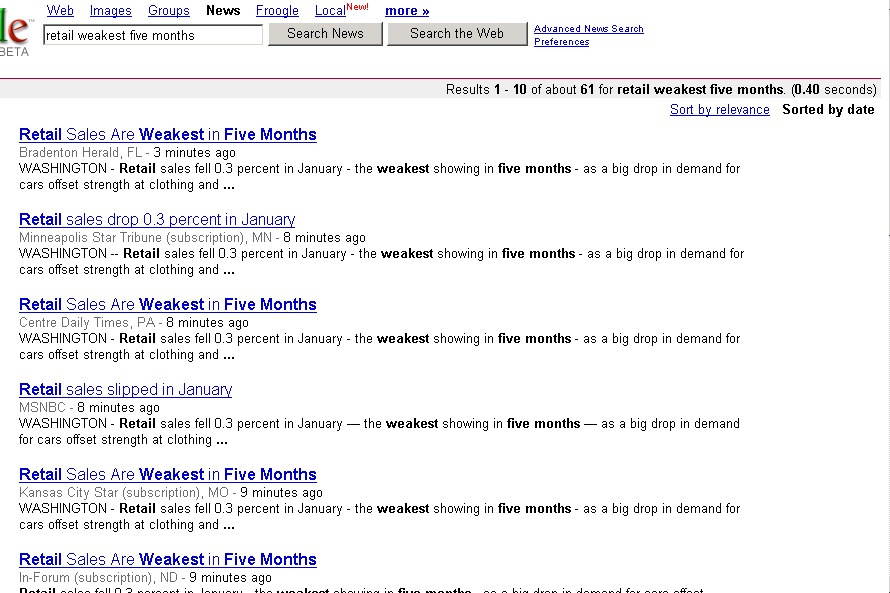
Given the circumstances, a perfectly acceptable beginning to the year. So what, you ask, is the favored elite headline and lede (capture here)?
"RETAIL SALES WEAKEST IN FIVE MONTHS."
And journalists wonder why the blogosphere is trampling their kingdom. Or why a majority of Americans distrust them.
DEWEY DEFEATS TRUMAN! LOSES TO TRUMAN! WHICHEVER IS RIGHT, THAT'S WHAT WE INITIALLY SAID!: Early this morning, the Associated Press released a negative article on the Commerce Department report with headline as above, "Retail Sales are Weakest in Five Months." Oh, but that was before Wall Street's opening bell. Just after two o'clock Eastern, in light of the stock market taking a decent report and an inflation-hunting Federal Reserve in stride, the Associated Press released a report with headline, "Stocks Move Higher on Strong Retail Data."
I'd make a piquant reference to our swapping ally Eurasia for Eastasia but ham-handed doublespeak doesn't deserve it. I'm satisfied with the image of a poorly coordinated two-man horse team tearing their costume in half.
Early tomorrow morning, Saturn probe Cassini flies by moon Titan for the fourth time.
While elite media agencies daisy-chain police blotters and end passive sentences about "violence" with the misleading phrase "across the country" for the sum of their above-fold reports on Iraq, Arthur Chrenkoff compiles news that best describes the nascent democracy's progress — news that just happens to be positive. Chrenkoff is thorough, though he has quite a lot to work with. The sheer volume of information on Iraq's liberalizing, modernizing and prospering economy, industry, education and civil society is enough to overwhelm the argument that gangsters shooting up bakeries have any control over events.
Notably, federalism — a clear separation of powers between central, provincial and local authorities — is quickly becoming as attractive to Iraq's Shiite political groups as it has long been for Kurds.
My commentary on universal principles of liberty has been respectfully criticized as "occasionally unjustifiable," especially for countries with no history of democratic "grassroots." Ba'athist Iraq, of course, was one of too many countries in the world suffering a near-complete absence of those grassroots. Yet, reflecting historical examples, we can see a developing bonanza. Laying natural rights of man as a foundation for governance, through the intervention and guidance of some form of temporary occupation, military or civilian, yields far better results than those nations left to trust the good intentions of a strongman minority.
As for optimism: even in the darkest of times, losing faith won't bring a sweeter end.