
What does the surface of Titan, Saturn's largest moon, look like? Ethan Hawke demonstrated to Jude Law in the movie Gattaca by blowing cigarette smoke into his glass of wine. NASA figures it's Dagobah painted orange — minus Yoda, swamp creatures and slow-motion hallucinations of Darth Vader.
In six days, the world will have the chance to find out. Space probe Huygens has detached from main craft Cassini seven months after Cassini-Huygens entered Saturn's orbit, and is due to touch down in early morning this coming Friday, January 14th. That's worth a short night's sleep, don't you think?
Three years into the war on terror, the press' treatment of any unsatisfactory operation shouldn't surprise us: mainstream news agencies are relishing the fact that American forces "Drop[ped] Bomb on Wrong House." Forces were closing in on a terrorist ringleader and, from the sound of the official report, ended up sending the thug to his deranged paradise ahead of schedule. Five are believed dead. Of course, the terrorist's friends tell of women, children and orphans killed in the strike, who were then whisked away to be buried in a place nobody can find. Reuters editorialized a caption for one of its photographs, hoping that the incident would make an awful lot of people angry.
But it's an Associated Press agent who wins a prize for the most strained negative assessment:
U.S. officials acknowledge the [Mosul] area is still too unsafe for the elections to take place there safely.
Yes, and while sand continues to be sandy, the sky blue and water wet, terrorists acknowledge that they haven't come close to stopping the vote.
LEFT OUT: I missed this release, which won't come near an elite publication:
Multi-National Forces detained a key leader [named Abu Ahmed] of the al Qaida-linked Abu Musab al-Zarqawi terrorist network in Mosul on Dec. 22....Security forces in Iraq have previously announced the capture of Abu Marwan, also a senior-level terrorist in the Talha organization. Security forces also recently captured another senior Talha member whose name cannot be released due to operational security reasons.
"Currently, security forces in Iraq have three of Abu Talha's four most senior leaders in custody," [Brig. Gen. Erwin F.] Lessel said.
The capture of these key members has led to additional captures throughout the Mosul-based AQ-AMZ network. More than 20 percent of Talha's key members have been captured in the past few weeks.
Having occurred in mid-December, we can see this victory reflected in others.
Mosul, Iraq, harrassed by terrorist stragglers from Fallujah, brushes danger aside:
Multi-National Forces from 1st Brigade, 25th Infantry Division (Stryker Brigade Combat Team), are working with local-based companies on various construction projects. Soldiers of the 133 Engineer Combat Battalion, with Mosul-based contractors, are working to improve roadways on more than 104,000 square meters of roads in different locations throughout Mosul.
Thursday's Central Command operations summary indicates, after a number of successes against Iraq's enemies, a growing societal common good as Iraqi civilians step forward in greater numbers to expose the terrorists in their midst.
Elsewhere, American and Iraqi troops have been scuttling terrorist cells and capturing arms.
Marines in al Anbar province provided local authorities with two ambulances in time for throngs of pilgrims making the Hajj.
An unusually large terrorist improvised explosive device killed seven soldiers in a Bradley Fighting Vehicle, and the death of American soldiers pleases no one but the enemy and its sympathizers. The circuitous methods used to murder the Bradley crew and others, however, suggest that terrorists have little recourse but to continue following a strategy to weaken American public opinion — despite President Bush's November victory and American policy's attendant four-years reprieve from media-manipulated, fickle popular sentiment. Ali Fadhil's observations from Baghdad confirm that Iraqi determination to hold elections and build a pluralist government has only strengthened in the face of attacks from terrorists — whose Syrian and Iranian masters, Ali notes, could not possibly be pleased with Iraq's inexorable march towards elections.
That's the way to do it:
U.S. employers added 157,000 workers overall to their payrolls in December, bringing the year-end total of new jobs to 2.2 million, the best showing in five years. The unemployment rate held steady at 5.4 percent.The Labor Department reported Friday that the 2.2 million new jobs created in 2004 were the most in any year since 1999, when employers added 3.2 million positions, based on a government survey of businesses.
2.2 million non-farm payroll jobs make for an employment boom thirty percent higher than the White House's forecast in June 2003, then derided by critics as overly optimistic. Journalists unsettled by the report are left to point at the 11% discrepancy between payrolls and economists' consensus forecast, despite the fact that numbers for October and November were revised upward by a total twice that amount. Or, as in the case of the AP story quoted above, ink was spent on a minor misstatement from the president.
It's good news.
Jonah Goldberg talks law and morality:
How many people consider "whatever you can get away with" to be the moral standard today? Answer: too many. What [Oliver Wendell] Holmes took for granted were the reasons people tried to cluster around the "external standard." A more Hayekian — heck, a more reasonable — man would understand (or in Holmes's case, care) that men have good manners and good values not because they are taught good manners are more efficient (though surely they are) but because good manners and good values are simply right. A good mother might very well explain to her children that proper manners and respect for others will make their lives easier. But, a good mother will surely explain that proper manners and respect for others is the right thing to do even if it makes your life more difficult. As the saying goes, character is what you do when no one's looking.
I've made that point many times: pragmatism, an unstable straddle of relativism and absolutism, can be safely practiced by individuals who take their moral upbringing for granted. Pragmatism as a societal value can slide quickly into antinomianism and nihilism.
Many years before I became an American Baptist, one of my favorite priests told a sermon (too short a sermon, one of my many reasons for conversion) that initially came across as a practical use for Christianity. "When everything is stripped away, it's always there for you to fall back on," he said. It seemed pleasant enough, but put to the question of law the statement is far weightier: left with nothing else, if one cannot consult a universal standard, the Divine, he will make do with Self, and sink into the relative.
Goldberg also touches on Oliver Wendell Holmes' "prudent member of the community," and the old justice's belief in legislation through a population's collective, pragmatic agreement. Strict leftism as experienced in America poses a specific threat to that academic arrangement: tyranny of the minority. If the consensus of a majority is challenged and charged as invalid for reasons ranging from "unfairness" to "insensitivity," society faces not only fragmentation, as every cultural or ethical deviance is offered acceptance by relativists but also oligarchical subversion. Such a minority, able to dictate its terms as a modified, collectivist equal or superior to a democratic majority, is particularly capable — which is why the left, never to be a majority, is frantically trying to regain the loss of its intellectual, pop-cultural and journalistic monopolies.
Mohammed Fadhil reports on Iraqis' election preparations. There are security concerns and solutions being proposed, as well as political activities we'll find familiar:
Most of the [200 political] parties are focusing now on the universities in an attempt to win the students votes and they're holding lectures and events in the universities to advertise for their platforms and lists.In the city of Najaf, the Hawza suspended the activities of its school and asked the students to stop working on their [research] and head to the provinces to encourage the people to vote.
The higher commission will grant all candidates a chance to speak through the media (papers, TV and radio) for a certain time for free and has asked the interested candidates to contact its offices to enlist their names on the broadcast schedule that is going to be coordinated with the Iraqi media.
For those who haven't heard, there are 7,200 registered candidates running throughout the country. Mohammed also debunks what's apparently an urban legend being circulated by those opposed to a democratic Iraq.
Finally: if "Philistine" has come to mean "disbeliever," "Iraqi" ought to soon be short for "courageous, indefatigable, not to be trifled with." (Link from Omar.)
IN-AP-PROPRIATE: Sometimes a hydra is just stuck trying to walk in seven different directions.
The National Review gang at the Corner is discussing the needlessly contentious confirmation hearings for Attorney General nominee Alberto Gonzales and the matters wrongly conflated with the man's work as White House Counsel. Says John Derbyshire:
Why is the thought of U.S. troops misbehaving so obsessively exciting to some Americans, rousing them to such furious indignation? I don't get it.
That's because you care for, admire and believe in the people of this country, able as you are to recognize their faults from part to whole. On the other side, we all know cynics. They set low standards because it's the most purely practical way to live, and they delight in the inevitable — if brief and soon overcome — stumbles of those who aspire to virtue. "See, you're not such a saint after all," cynics sneer, and further excuse themselves from responsibility.
If someone has invested their identity in the idea that America stands for nothing good, they will be forced by overwhelming evidence to choose between discarding most of their world view or keeping it by segregating perception between evidence they do and do not want to accept. As, in the war on terror, evidence of American grace, honor and mercy has accumulated rapidly, phobics have sacrificed more and more declared values — civil and political rights, concern for the world's downtrodden — to remain firm in their opposition while waiting for something, anything, that might publicly justify their contempt. American benevolence is strong because we take ourselves very seriously. When some of us falter, detractors — doubtful of both virtue and redemption — take that for an Achilles' heel.
It's not the years, honey, it's the mileage: overjoyed at the unexpected, NASA celebrated stoic Mars rover Spirit's first birthday on Monday.
The families and loved ones of police recruits in Hillah murdered by a terrorist bombing will mourn over the senseless deaths, but the attack will bring little else for the enemy. Attacking Iraq's police forces, specifically the targeting of prospective recruits lined up in front of stations, has been one of the terrorists' weakest tactics over the past two years. After every bombing, equal or greater numbers of Iraqis have shown up elsewhere to take part in their new state. On the street, police have occasionally been outgunned and their failures have received prominence in mainstream media reports — though their impressive victories, especially those of late in Mosul, have not.
Proper Use of Terrorist Explosives, Part II: Iraqi National Guardsmen caught a saboteur with his pants down, and the improvised explosive device the terrorist was trying to lay went off. Perhaps inflamed by the untimely disintegration of a fellow, a handful of terrorists engaged the Guardsmen, only to be routed.
While the 1st Cavalry Division wiped out a series of thugs' dens in Latifiyah, the 1st Marine Division rounded up over a dozen of the enemy and detonated their hoard of Saddamite arms.
With few exceptions, the enemy is only able to cause destruction and the loss of life among the unarmed, the defenseless and the isolated. As I noted nearly a month ago, the Ba'athist-Islamist combine is struggling towards an objective made difficult last April with Iraqis rallying against terrorists and impossible in November with President Bush's reelection. America is particularly adamantine; one almost wonders if in their ignorance, terrorists thought they were dealing with a parliamentary democracy that might succumb to a ruling coalition's vote of no confidence. In Iraq, what acts of terror make for disturbing press headlines and furrowed brows on a few bureaucrats tempted to surrender Iraqi elections to authoritarians do nothing to affect the larger part of the country.
If ninety percent of Shiites and Kurds, who together represent eighty percent of Iraq's population, intend to vote, the country's turnout will rival that of the most active Western nations. It has become common to hear Iraqis, particularly those wounded in attacks, defiant of the terrorists trying to enslave them. If Sunnis are reasonably spoken for by this man, the Near East authoritarians' defeat in Iraq is complete, elections on the 30th just a reminder of the ineffaceable.
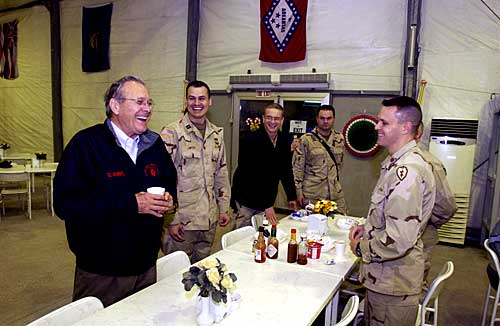
I received a link to this photograph from my parents' city councilman and my fellow Republican, Duane Limpert. His son, Duane Jr., is immediately to the right of Defense Secretary Rumsfeld. Duane Jr. graduated from West Point and was recently deployed to Iraq, serving in part as his brigade's public affairs representative. It was his unit that was bombed by a terrorist killer on the 21st of last December; thankfully, especially for his family, Duane was not near the hall at the time. In an early December letter home, which my GOP club gratefully reprinted in our newsletter, Duane remained wary of a society heretofore based on power and fear but was very optimistic about the success of his country's mission. I doubt either opinion has changed since.
Duane Jr. and I both grew up in North Olmsted, attending the same middle school and high school but we didn't know each other personally. In the seven years that Duane and I were in the same building, I probably shared two classes with him: gym one year and lunch another. Through my political involvement I know his father better than I do him, but there was something that struck me about Duane. He and I were about the same size in school, short and skinny; maybe he was even a bit tinier. But he ran with the athletes, playing every sport he could — soccer, football, basketball — and perhaps suffering for his size, for I remember him as always with a cast on one arm or the other. The big guys took him in as one of their own, and by the end of twelfth grade Duane was one of the most respected students in school. He thought tough, and was tough.
Here's to his hard work, and the rewards it will bring to all.
