
Robert Moog is dead — but the wave still oscillates.
As an amateur musician with some undergrad schooling towards it, I've enjoyed a hobby over the last seven years in audio recording and production. A transition to other interests, notwithstanding a rather abrupt end eighteen months ago to the most involved and musically intimate ensemble I've ever been in, has left me working on this little sidecraft only occasionally. (Though not without a recent triumph or two.) It's also left me with a penchant for sifting through old bits and pieces every now and then, from ditties to demos to full mixes of classic songs I and the boys (or just I) did, while I work on the computer. Tonight I dug up a goof-off made with layered saxophones, from the doldrum days in January of 2001; playing at first against a heavily compressed drum sample of distance acquaintance Mike D., then to recordings of myself. By then I had been playing saxophone only a few times a year for four years, leaving the eight years of study in elementary, middle and high school behind as a toy in the chest — to bring out on rainy days or for the rare musical need and ride like a bike, hopefully not falling off.
Here it is. Goofy. A little sloppy. Playful? I've always liked it, never one for too much spontaneity. (It actually came with a voiceover track running an inside joke, but you'd have to ask me very nicely to get that cut, and then risk not finding it funny.) I never cared for virtuoso work, in 11th grade squeaking through on the first movement of Jacques Ibert's Concertino de Camera only when without altissimo and an entire eight beats per minute. Jazz is only something I've begun to wade into as a listener the past year or so; back in the day I was content with a single Charlie Parker transcription and otherwise regarded jazz and jazz musicians as one does Formula One racers as they whip past. Paul Hindemith's Sonata for Alto Horn I loved. Meant for the frumpy Eb horn, the sonata was much more charismatic, mysterious and colorful on the alto saxophone (as evidenced by this performance on Amazon, track number four). Paul Hindemith at his most melodic was more romantic than Romantic. Technique was less important than understanding and inflection. Earnestness got you far.
Adobe has released the latest update of its audio program, Adobe Audition, formerly Cool Edit Pro 2.0 by Syntrillium Software. Including improved workflow and layout, Audition 1.5's new features range from VST plug-in support to pitch correction, to integrated CD burning and even a vocal extraction effect that works quite well.
I've been working with audio production as a hobby since 1997, and bought Cool Edit Pro in the summer of 1999. Although I have been eyeing Cakewalk's Sonar program lately, Adobe Audition remains an invaluable audio tool with one of the most intuitive, streamline graphic user interfaces on the planet. Check it out.
These Aughts are a far cry from the Dublin boys' salad days, when their first four albums were recorded and released in as many years. U2's 2000 record All That You Can't Leave Behind was successfully poppy, if less inspired than their best. Adam could still pull off the occasional surprise; Larry had simplified his drumming technique to the point of mass production; the Edge was repeating himself, rather than "coming full circle," and conducting sonic experiments that resulted in sounds more peculiar than inspiring; and Bono's voice was, to put it politely, ready for retirement. Most conversations I've had about the band end with all parties agreeing the four are best off breaking up on a good note, and that another album from the world's most famous Irishmen would not be wise.
So what to make of news about a Fall 2004 release? Bono's penning songs whose titles belong in Praise & Worship hymnals, on melodies written by an "angry Edge," possibly under the direction of the man who produced the Sex Pistols. "Back to the basics," says Edge. They've been using that phrase since Zooropa and Zoo TV finished up ten years ago. But who am I kidding? I'm game.
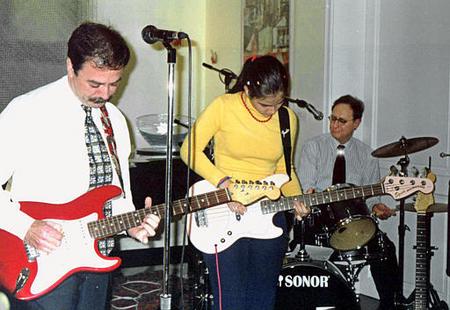
Left to right: Hungarian Ambassador Andras Simonyi, his daughter Sonja, U.S. Ambassador to NATO Alexander Vershbow. Read the story behind the photograph.
I almost feel like a traitor to my generation. I recently borrowed Genesis' 1973 album Foxtrot (which is a fantastic album, by the way) and was bowled over by the lack of compression and limiting evident in its mixing and mastering. Dynamic range, even compared with early 1990s releases, is enormous. I doubt much more than a 1.5:1 ratio was set on Phil Collins' kit's overhead tracks or the overall drum submix.
Tuesday evening I was driving home from an engagement, blaring Foxtrot. After "Supper's Ready" faded out, I slipped in Weezer's blue album. Now, I love Weezer just as much as the next rocked-out nerd who wishes he owned an SG (but makes do with a 335 clone) but the intense compression - usually subtle, proof of good production - threw me for a loop. I actually craved Foxtrot's lack of punchiness. (And clarity from the lack of limiting distortion.)
Older and less aggressive can be better. Imagine that!
Those of you who are trained musicians will be quite familiar with the tritone, or diminished fifth. It occurs naturally as a pitch seven-fifths above a fundamental. Placed above a major third to the fundamental in the root position of a chord (inversion notwithstanding) called a dominant seventh, it is part of the most familiar cadence in post-Renaissance Western music - the perfect cadence.
Removed from an aesthetically pleasing position and simply played with the fundamental and - for good measure - an octave, the tritone is famously and aptly known as "Diablo in Musica." It tends to conjure all sorts of nasty, Heronymous Bosch-like visions of the devil and his minions crawling out of the upright piano, on which you would most likely be incessantly playing this interval, to wickedly and perversely "reward you."
Now, fast forward four hundred years. Have you ever noticed that computer printers, when in operation, almost unanimously emit tritone noises?
What were those Luddites talking about, again?
(As an aside, I'm bothered as to how quickly my academic knowledge of music has slipped in three years. I took 21 credits in college, finished both the music theory and ear training courses. I know the stuff intuitively - but writing this, I'd need to go back to my theory books to score a German, French or Italian augmented sixth. Italian's missing the third, right? Can't recall from the top of my head. Damn disuse!)
UPDATE: I took a quick refresher on augmented sixths. Cancel alarm. Everything's cool.

