
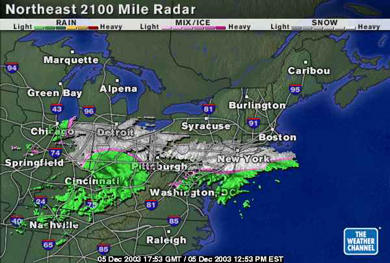
Trouble in paradise: weather agencies recently modified Northeast Ohio's medium-term forecast. Not only will the snow on the ground face rain showers tomorrow, but a white Christmas under the current projection looks iffy at best.
But then, over the course of two or three days one can watch a ten-day prediction change drastically more than once. Forecasting is a tricky and - at least according to today's philosophy - inherently tentative practice, often subject to as much luck as reason. That's probably why ExtremeTech believes that putting a finger to the wind isn't just for meteorologists:
We used to live in Los Angeles, where being next to the Pacific Ocean made weather forecasters uncannily accurate. Their forecasts almost never varied from day to day, however, so their record had little to do with mad weather skills. Where we live now, though, actually has seasons: rain, snow, wind, and tornados. Weather forecasters earn their keep, even though they're usually wrong. It's seemingly the only profession in which you can be wrong all the time and still collect a regular paycheck.
I wouldn't consider it to be that much of a crapshoot. But as anyone who spent even a single afternoon reading about taking barometric and air moisture measurements with objects from the kitchen and the toolbox, kit-bashing a reasonably accurate PC weather station is only a step or two beyond:
Although long-term weather forecasts rely on massive, expensive supercomputers, the much shorter time frames and smaller region you'll analyze with simulation software in this project place far lesser demands on your PC, so much so that the requirements for the PC you'll use for your weather station really are minimal. [E]ven a processor slower than 300 MHz running Windows will do.
The article offers, among others, a link to an aging yet relevant site explaining introductory concepts of chaos and order in weather behavior. (Physics class never really took, so the double-pendulum had me as fascinated as a seven-year-old in a science museum.) Is there a method to Mother Nature's Madness? I've been able to distinguish a few patterns over the years. Otherwise, I make my judgments from a combination of the Old Farmer's Almanac and the Weather Channel.
So: where's that snowy Yule you promised, gentlemen?
So spake a Toro commercial's voiceover on the radio today.
I love it. Who would choose to drive to lunch and go through the tasks of wiping off the car, defogging and heating it before driving on slushy roads through steady snow showers - keeping five miles per hour below the speed limit except when behind plow trucks, in which case ten miles per hour? I would. My only regret is that I lack a carry-around digital camera.
Tomorrow morning I'll be going tree-hunting with the family down south, in what will probably be the most seasonable weather since Christmas 1982. And yes, you're damn straight that I remember.
For the last three days, the sky has been filled with low, leaden clouds that turn pink and purple past four o'clock in the afternoon: snow clouds. Yesterday's high temperature reached the mid-fifties, but last night's lows dipped into the thirties. I was just ambling into my car this morning when the same heavy ceiling dropped a few hard, heavy droplets onto the pavement - somewhere between hail, sleet and snow, but close enough for me. I half-expected the local, Classical NPR affiliate to spin a few winter jingles but the news had already begun; so I gave Sleigh Ride a couple of acapella verses and choruses as my car sped down slick lanes, snow-dusted houses and lots on either side. October 2nd? Old Man W.'s on the ball!
Now we can all admit to, at one point or another in our childhood, seriously anticipating a Christmas season identical to the New England standard: no grass to be found for six months out of the year. Some want no part of it - but others, like me, can't get enough. The early Eighties proved to be rich snow seasons for Ohio; 1982, I seem to remember, was a landmark year with a four-foot-drift storm in January or February. Volume petered out over the years, leaving us with a good number of Green Christmases, until the mid-Nineties gave much of the Rust Belt and East Coast muggy, brown winters culminating in "Christmastime in Georgia," as my New Jersey-expatriate uncle put it. 1995's winter break was heralded by a mini-blizzard, but it was the exception. Not pretty. And if the weather can't crack the freezing point, I'll defect and ask for sunny-and-seventy.
Fortunes changed over the past four years: since 1999, snow has dropped in the nick of time for the 25th. Last year bore all the signs of my mother's fabled Michigan Christmases of the 1950s and 1960s: a White Thanksgiving; snow early, snow often. Christmas was picturesque, and the cold spell was drawn out until late January. This year, the Old Farmer's Almanac is predicting a strong winter; my own observational understanding holds that the wetter and stormier the summer, the more solid and snowy its following winter. The past four months couldn't be classified as mild, so I'd consider today's little introduction to the fourth season a trusty harbinger. Time to hunt for the gloves, overcoat and hat.
Looks like Earth has her own Great Red Spot. Enormous, isn't it? I'd go into the intriguing similarity of hurricanes to galaxies, but the photograph itself is enough to ponder for one evening. And awe of majesty is already turning to wariness as the East Coast braces itself for Isabel's possible landing.
...My regards to Bob Newhart. Dennis Prager blows the lid off of the myth that works of Shakespeare can be produced by large numbers of man's older cousins when equipped with word-processors:
According to news reports, instructors at Plymouth University put six Sulawesi crested macaque monkeys in a room with a computer and keyboards for four weeks. Though one of the monkeys frequently typed the letter "s," the other monkeys ignored the keyboard, preferring to play with one another and with the ropes and toys placed there. When they did pay attention to the keyboard, one smashed it with a stone and the others repeatedly urinated and defecated on it.
Indeed, it was the blurst of times. The rest of the article is a worthy critique of the belief denying an intelligence - any intelligence - behind creation and evolution.
Also: Prager plays the relativist leftist, in response to Tony Blair's speech to Congress, a tiny bit too well. I'm certain I've seen those arguments pop up in the comment threads at Tacitus' more than once.
Creationist I am not, so this news finds me wide-eyed:
In the 160,000-year-old fossilized skulls of three Ethiopians — two adults and a child — scientists think they see for the first time the faces of the immediate ancestors of modern humans.Except for a few archaic characteristics, they are as recognizable as Hamlet's poor Yorick. They are longer than those of earlier ancestors or any contemporary Neanderthals in Eurasia. Their midfaces are broad, but the nasal bones are tall and narrow. The brow ridges are less prominent than the glowering visages looking down from earlier branches of the family tree. And the cranial vaults are higher and within modern dimensions.
[...]
"We can now see what our direct ancestors looked like," said Dr. Tim D. White, a paleoanthropologist from the University of California at Berkeley, who is a leader of the international team that excavated and analyzed the skulls.
That had been impossible until now because of the frustrating gap in fossil evidence between 100,000 and 300,000 years ago, the presumed interval of transition from prehumans to modern humans.
They're not just whistling anthropological Dixie. This very well may solve a certain mystery about competition:
The discovery team and other scientists said in interviews that the research appeared to confirm the idea that modern humans originated in Africa and then spread into Asia and Europe. In that case, they said, the enigmatic Neanderthals, which became extinct in Europe 30,000 years ago, could not have been direct forebears of today's humans.[...]
...Dr. White's group said the fossil skulls showed that Homo sapiens with almost entirely human characteristics had already evolved in Africa before Neanderthals evolved into their classic form. Soon afterward, fully modern Homo sapiens entered Europe, presumably from Africa by way of the Middle East, and the Neanderthals went into their fateful decline.
Incredible. Better yet: it'll be in National Geographic by the end of the year.
UPDATE: John Derbyshire throws a little water on this fire that shouldn't be.


