
The National Oceanic and Atmospheric Administration has come to town, and it's got something for everybody:
NOAA scientists today announced that a number of climate conditions will influence the winter weather across the United States from December through February. The NOAA 2004-2005 Winter Outlook calls for above-average temperatures in Alaska, much of the West and the northern and central Great Plains. Below average temperatures are expected across the Gulf Coast states, the Southeast and the mid-Atlantic region of the U.S. There are equal chances of warmer, cooler or near-normal temperatures this winter in the Northeast, Midwest and parts of Southwest.
And meteorologists believe they're getting better all the time:
NOAA continues to improve climate forecasting and push the envelope in understanding the Earth's climate system. For the first time, NOAA's new Climate Forecast System is being used as a tool for this outlook. The Climate Forecast System is a coupled ocean-atmosphere model, which complements other NOAA models and gives increased confidence of probable climate events before they happen."NOAA's progress in climate forecasting is based on ongoing research and collaboration with our partners, advancements in our understanding of the global climate system, upgrades to the weather and climate supercomputer, and improvements in the state-of-the-art atmospheric and oceanic modeling applications. The knowledge and understanding NOAA gains is allowing us to begin a new era in climate prediction," said Louis W. Uccellini, director of the NOAA National Centers for Environmental Prediction.
I wouldn't mind some breakthroughs in cloud-seeding, either. Are winter gloves on sale yet?
Orbital telescope Spitzer has just paid for itself:
NASA is reporting that one of its space telescopes has discovered what scientists believe might be the youngest planet ever identified, at less than 1 million years old. In its first major findings, announced Thursday, the Spitzer Space Telescope also has shown that protostars, or developing stars, are quite common and that the planetary construction zones around infant stars have considerable ice that could produce future oceans....The young planet is in the constellation Taurus, 420 light-years away — quite close by astronomy standards. It is believed to be on the inner edge of a planet-forming dusty disk that encircles a 1-million-year-old star.
According to other reports, the star's youth throws into question some currently held theories on the chronology of planet creation. Now, of course, we'll be watching this moment of solar formation for the rest of our lives as if it were stuck in time — one of mortality's occupational hazards, like a mayfly watching one day's construction of a cathedral. Our study, as always, depends on stars in different stages of their lives. Here's to finding more.
Funny I would mention the 1998 Syracuse Labor Day Derecho for the first time yesterday. We have a team down at the Fulton County, Ohio Airport today. They're "inside a small room, away from the windows." One look at radar jogged my memory: there's a squall line with fully mature bow echo characteristics — cyclonic, anticyclonic subcells — bearing down on Northeast Ohio. Characteristics I've seen before:
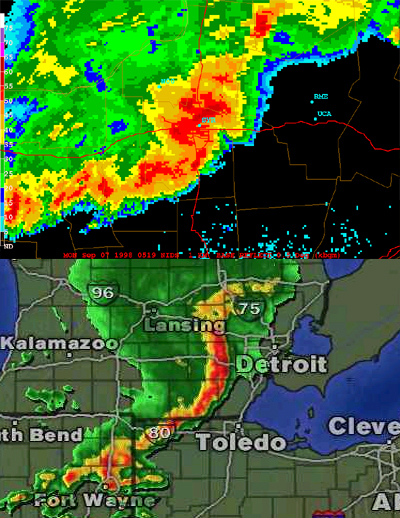
As we learned in grade school: spring and autumn are unsettled, exciting and dangerous. Don't forget your umbrella.
IT CAME, WE SAW: At about 3:45 PM EDT, the western horizon filled with the bulbous, black façade of the storm as it barreled east. Two minutes later, the world went black. The storm didn't toss us around too much — in 1998, rain came sideways within a minute. A lot of rain and tiny hail pebbles fell — the first hail I've seen in years — and until about 4:10, the sky was an impenetrable light green. Off into the east the squall goes, and I suspect we'll have clear skies by midnight.
AND: Actually, arrival was closer to four o'clock — that's the time at which every mechanical clock in the apartment stayed at for the better part of eight hours. And at ten, the skies were clear (it's midnight now, and flashes of lightning from a second storm are moving closer). Without power, I was able to take a few night shots from the balcony.


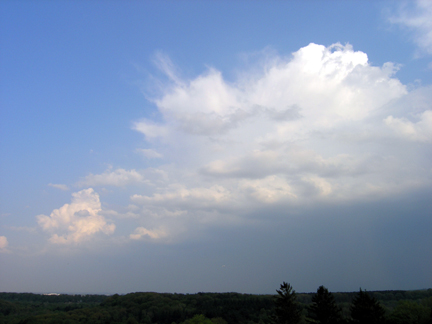
Very little commentary necessary here except my profound love for the digital macro zoom. And the fact that photos of thunderstorms will be regular guests on the uBlog.
It's not a giant, black obelisk nor green cheese. But it's from the moon, it's a mineral and it's never been seen before.
I'm a strict believer in seasonal delineation and meteorological normalcy - in the plainest English, it gets hot and all green-like when spring comes and it don't snow when it ain't supposed to. Winter aficionado as I may be, April marks my metero-political switch to an advocate for warm weather and sunny skies, punctuated only by brief, strong thunderstorms. If you live in the south, spring has already begun. Are you up north, as anxious for blooming and greening as I am? Feed your curiousity at the Greenreport, care of University of Kansas' Kansas Applied Remote Sensing Program. The good news is that despite below-average temperatures this year, blooming appears no further behind than last year's.
Two wonderful sentences from Universe Today:
More than 100 planetary systems have already been discovered around distant stars. Unfortunately, the limitations of current technology mean that only giant planets (like Jupiter) have so far been detected, and smaller, rocky planets similar to Earth remain out of sight.
They're wonderful because they're a recognition of the technological limitations to human discovery. Since orbit-wobble planetary detection began, press reports have almost exclusively explained astronomers' findings - enormous planets, brown dwarfs and nothing else - as an absence of small, nickle-iron-core planets like Earth, Mars or Venus. Not so, says UT, and the science-enthusiast public is for the richer:
How many of the known exoplanetary systems might contain habitable Earth-type planets? Perhaps half of them, according to a team from the Open University, led by Professor Barrie Jones, who will be describing their results today at the RAS National Astronomy Meeting in Milton Keynes.By using computer modeling of the known exoplanetary systems, the group has been able to calculate the likelihood of any 'Earths' existing in the so-called habitable zone - the range of distances from each central star where life as we know it could survive. Popularly known as the "Goldilocks" zone, this region would be neither too hot for liquid water, nor too cold.
By launching 'Earths' (with masses between 0.1 and 10 times that of our Earth) into a variety of orbits in the habitable zone and following their progress with the computer model, the small planets have been found to suffer a variety of fates. In some systems the proximity of one or more Jupiter-like planets results in gravitational ejection of the 'Earth' from anywhere in the habitable zone. However, in other cases there are safe havens in parts of the habitable zone, and in the remainder the entire zone is a safe haven.
Nine of the known exoplanetary systems have been investigated in detail using this technique, enabling the team to derive the basic rules that determine the habitability of the remaining ninety or so systems.
The analysis shows that about half of the known exoplanetary systems could have an 'Earth' which is currently orbiting in at least part of the habitable zone, and which has been in this zone for at least one billion years. This period of time has been selected since it is thought to be the minimum required for life to arise and establish itself.
Interpolation: a lovely thing. Read the article for yourself.
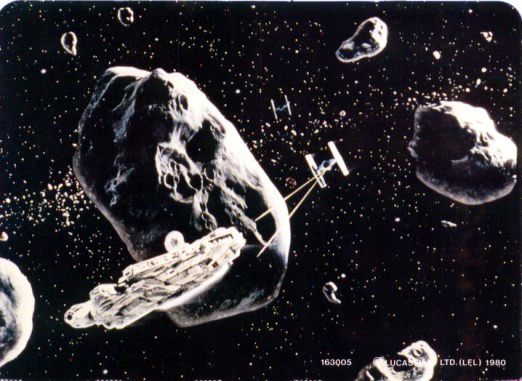
Via the Corner, NASA has responded to the unusual number (or unusually high news coverage?) of asteroids passing astronomically close to Earth - or Near Earth Objects - by formalizing a system of analysis, prognosis and notification. Now, before you begin worrying about a cataclysmic descent turning, say, Asia into a great, earthen amphitheater, keep in mind that a large meteorite impact has about as much chance occurring as does every dormant volcano simultaneously awakening while every tectonic fissure suddenly breaks into the Frug. And before you shake your fist at the asteroid belt, remember that protoplanets saved the Rebel Alliance. (The Falcon's odds, you should note, were only 3,720 to 1.)
Coincidentally enough, as I gazed up at the starry sky during my walk last night, a meteor skipped across the Van Allen radiation belt. I hadn't heard of any showers - what are the chances of such a sight in a single glance? Majestic.
One of my rules to live by holds that a teacher doesn't mix politics with lessons. In grade school, was your head stuffed with global warming - the fabrication which, if the Tooth Fairy ranked as a Big Lie, would qualify as a Crock of Bull the Size of Mount Kilimanjaro? Via IP, Michael Crichton condemns the scam of scams:
Nobody believes a weather prediction twelve hours ahead. Now we're asked to believe a prediction that goes out 100 years into the future? And make financial investments based on that prediction? Has everybody lost their minds?...Let's think back to people in 1900 in, say, New York. If they worried about people in 2000, what would they worry about? Probably: Where would people get enough horses? And what would they do about all the horseshit? Horse pollution was bad in 1900, think how much worse it would be a century later, with so many more people riding horses?
Take ten minutes to read it thoroughly and arm yourself with a few sharp maxims, so if in conversation someone references global warming as if it were serious, you can quickly and cleanly throw down a little reductio ad absurdum. Like this one: "Whenever you hear the consensus of scientists agrees on something or other, reach for your wallet, because you're being had."
What better way to whet my fascination with all things meteorological than to focus on the question of why. Weather is what the wind brings us - so why not build your own analysis of archived jet stream footage?
(Speaking of which, the battle for a white Christmas continues. Here Northeast Ohio enjoys a hefty amount of lake-effect snow today, and by early next week temperatures will rise above freezing - followed by rain. Current forecast, that is. Canada's certainly good for one thing: cold air. Stream, jet, stream!)
RUN, PASS, RUN, PUNT, TURNOVER, ETCETERA: The Weather Channel has shifted its forecast back to a more palatable holiday. A classic wintry mix is predicted for Christmas Eve, followed by snow showers on the big day. That was essentially the forecast yesterday, and at times I cock an eyebrow wondering if they're sweetening things just for romantics like myself. It's still about a week away, though, and conditions could vary quite a bit. This is like a ball game.